
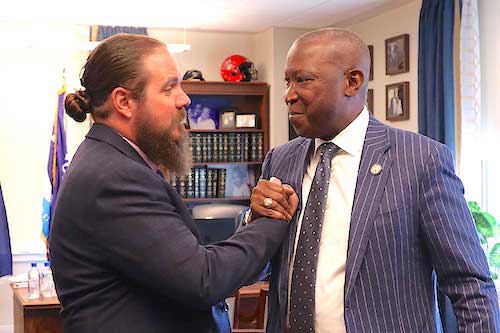
Conversations hit on funding cost-share programs, farmworker exemptions, utility-scale solar facilities, meat misbranding, pesticides, large animal vets
~ Press release provided by Virginia Farm Bureau Federation
RICHMOND — Real voices and genuine stories took center stage as Virginia farmers and producers traveled from across the commonwealth to meet with legislators at the Virginia Capitol.
The event was part of Virginia Farm Bureau Federation’s annual Legislative Day where more than 100 farmers informed lawmakers about the direct impact legislation will have on their livelihoods and in their communities.
Conversations covered a range of agricultural topics, including funding the state’s cost-share program; maintaining the farmworker exemption from minimum wage and overtime; utility-scale solar facility siting; meat misbranding; crop protectants; and the large animal veterinary shortage.
During a meeting with Lt. Gov. Hashmi, farmers voiced their support for HB 508 and SB 340, which define agrivoltaics in a way that prioritizes agricultural production, with solar arrays as a supplemental component to a farming operation.
The definition ensures agrivoltaics systems, “work in conjunction with an operating farm that benefits both the farm and other users on the power grid,” said Coty Goodwin, an Orange County beef cattle producer.
Farmers also stressed the importance of preserving local authority in solar siting decisions and cautioned against establishing statewide ordinances.
“The best decisions are made at the local county board of supervisors where we can sit down and look at each unique situation,” Goodwin said. “We don’t want our localities to lose the power of making their own siting decisions.”
Farm Bureau supports HB 322 and SB 186 to require proper labeling for alternative protein food products that indicate the origin and contents of the ingredients.
Misbranding “causes so much confusion at the grocery store,” said Amelia County dairy farmer Cecilia Moyer. “It’s very important to have clear labels so consumers know what they’re buying.”
The Senate bill passed unanimously.
Farmers from Southside Virginia met with Aaron Yohai, legislative aide for Del. Vivian Watts, D-Fairfax, about labor and crop protectants. They voiced opposition to HB 1375, which would ban the manufacturing and sale of paraquat, a critical pesticide used by corn, cotton, soybean and peanut growers.
Pittsylvania County farmer Donny Moore noted that applicators are already required to complete training to use pesticides. An outright ban would add further hardship to crop producers because, “right now there’s nothing else in our tool bag to take its place.”
VFBF board member Robert J. Mills Jr. and Loudoun County farmers met with Sen. Kannan Srinivasan, D- Loudoun, and Syreeta Martin-Glenn, legislative assistant for Sen. Jennifer Carroll Foy, D-Fairfax and Prince William. They discussed HB 20 and SB 121, which would eliminate minimum wage exemptions for farmworkers, and underscored the added strain this would have on agricultural operations.
Farm Bureau advocates for eliminating the H-2A and H-2B programs from the legislation. Mills noted that farmers cover housing and transportation costs under the programs, which effectively push wages above the minimum.
“Virginia is the only state in our region that’s taking out the minimum wage exemption,” Mills said. “Our margins are already so thin and this would put us at a competitive disadvantage to surrounding states that do have these exemptions.”
Additionally, complimentary snack bags with Virginia-grown, value-added agricultural products were distributed to each lawmaker throughout the morning.
Keep track of agriculture-related legislation at the VFBF Plows and Politics blog.
•••
RELATED ARTICLES
Winter storm damages farm structures in Shenandoah Valley
Poultry sector’s expanding influence reflected in 2025’s consumer trends

Be the first to comment