
Hawksbill Creek consistently showing highest levels of E. coli
By Dylan Cooper, Outdoor columnist
This past Wednesday evening, I stood on the banks of the Hawksbill Creek along the Greenway with my toddler, staring into the calm, clear water. It had been a high of 107 degrees F on my Acurite weather station for four days, and an afternoon thunderstorm had finally cooled things off enough to bring us out of our air-conditioned hideout.
The Hawksbill seemed so inviting to us two water-loving outdoorsmen. The depth was only ankle to knee deep, with clean rocks, no algae, gurgling little bubbles, small fish jumping, and ducks of all sizes swimming about. It was the perfect setting for me to introduce my son to the same freshwater ecology I am so passionate about protecting.
But I also knew that at the same time, just a half mile upstream of us at the pedestrian bridge, the Friends of the Shenandoah River (FOSR) volunteers were taking their weekly water quality sample, and it was likely destined to be bad news.
See, the Hawksbill has been the extreme outlier for high levels of Escherichia coli, the species of bacteria found in the intestines of warm-blooded organisms. If certain harmful strains of E. coli are ingested, as can happen when in contact with stream water, it can cause symptoms from intestinal issues all the way up to death (various studies show the mortality rate from an E. coli infection is somewhere between 8% and 35%), and it is especially dangerous for young children and the elderly.
This isn’t just the same ol’ E. coli our grandparents had when a deer pooped in the creek they drank from. The emergence of antibiotic resistant genes in E. coli,stemming from overuse of antibiotics in both humans and livestock/poultry, has led to an increase in multidrug resistance while treating those infections. Meaning it can make you sicker and harder to treat than ever before.
Therefore, E. coli is used as a water quality parameter to estimate contamination by fecal matter, and it’s a very important one for places of frequent water recreation areas like those along the entire 2 miles of the Greenway. Using private and public donations,FOSR tests sites all over the Shenandoah River watershed on a weekly basis from May to September, the peak times for water recreation. They then send those samples promptly for testing in a lab. FOSR’s water-quality monitoring programs volunteer told me: “Shenandoah University has generously provided space on the main-campus in Winchester for Friends of the Shenandoah River to house our water-quality testing laboratory.”
The testing site for Hawksbill Creek in the Town of Luray was added in 2024 and is currently the only “creek” in their list of sites. Last year, as you may well remember, we were in some stage of drought from May through September and many feeder creeks were dried up. Despite the low flow conditions, the Hawksbill continued to test above the recommended limit for E. coli for the entire season except the very last sample on September 9th, 2024. The average level was 671 MPN CFU/100mL compared to the EPA recommended “do not exceed” limit for freshwater, which is 235 MPN CFU/100mL. That’s nearly 3 times the limit, on average, the whole summer. So for 16 out of 17 weeks it was unsafe to swim/wade in the Hawksbill Creek. How is it looking this year? So far the Hawksbill is batting 1.000 and have had the highest levels out of all the testing sites every week, no matter if the Hawksbill is clear and the Shenandoah River is muddy. That is just awful.
Waterborne bacteria like warm temperatures, high organic matter, and lots of fine sediment…. Three things the Hawksbill has plenty of no matter the flow in the summer. Also, E. coli can live in the streambed and bank sediments for months, providing an almost constant “leaky” source and re-emerging at higher concentrations when a sudden storm causes high flows that disturb the sediment, or even just from the disturbance from machinery, humans, or animals. After high water events is usually when FOSR sees the worst E. coli levels, and so the saying goes “when the water is brown, turn around.” Yet as we’ve seen, the Hawksbill can be very clear, and near drought stage, and still have E. coli levels well above the EPA recommended limit for freshwater beaches.
Where does all this E. coli come from in the Hawksbill? Let’s first think about the potential sources, which are plentiful and complex. Starting in town, you have streets, buildings, sidewalks, grassy areas (all places where animals can defecate and have runoff) and even sewer lines criss-crossing the creek. Continue to follow the creek upstream as it meanders through the valley and you’ll see plenty of ducks, geese, cows, horses, sheep, dogs, and cats. Keep going and you’ll see fields sprayed with all kinds of $#!%, houses with old septic systems (even potentially some illegal “straight pipes”), a dog park, chicken houses, pastures, and feed lots. Upstream further: you go past deer, bear, and other wildlife. Go as high as you can go up the creek and you’ll come to the Hawksbill’s source, Lewis Falls, a tributary that is literally sourced from the wastewater treatment plant at Big Meadows (which does reportedly have UV bulbs to kill bacteria as their final step).
Some of these are called “point pollution sources,” like as in if you can point your finger at the pollutant effluent entering the stream, and they are typically the easiest to combat if they are a problem. But the majority of where bacteria comes from in the Hawksbill Creek watershed are “non-point pollution sources,” specifically agriculture, and this was proven in a TMDL report published by VA DCR/DEQ almost 20 years ago as “A Plan to Reduce Bacteria in the Mill and Hawksbill Creek Watersheds.”
To summarize, in 1998, Hawksbill Creek was first listed on the Clean Water Act’s Section 303(d) list as impaired for coliforms. Subsequent reports every few years continued to list the Hawksbill as impaired for E. coli, and it continued to expand the impaired segments until by 2006 it covered the entire ~20 miles of stream from the headwaters in SNP to the confluence with the SF Shenandoah River.
The 2007 TMDL report was able to use Bacteria Source Tracking analysis to find that of the E. coli contaminating Hawksbill Creek, humans contributed 1%, pets contributed 16%, wildlife 35%, and the near majority was livestock at 49%. Now, a lot has changed in the last 18 years, but it was not necessarily all for the better. This “TMDL Implementation Plan” had put in place a goal by 2022 of 100% implementation of all Best Management Practices such as livestock exclusion fencing, septic system repairs, vegetated stream buffers, pet waste programs and the list goes on and on as to what practices were planned to be done to remediate the E. coli levels. Obviously, you can look around the watershed and realize the goal was not met, and the data continue to prove it.
So what can we do? As a community, a whole lot. Of course we could study it some more… Another TMDL study would cost quite a lot just to tell us we hadn’t met our goals, the bacteria levels are still high, etc. We could expand testing further up the watershed to figure out which segments or tributaries are the worst problems. We can work with farmers to take advantage of all the incentives that our tax dollars are paying for in order to make farm improvements so that the water sent downstream is of higher quality. There are a whole host of Best Management Practices that can be done on a farm-by-farm basis with help from the Natural Resource Conservation Service, the Soil and Water Conservation District, and VA DCR who just received record levels of state ag cost-share funds.
We can also do other things to promote overall stream and riparian health like addressing systemic streambank erosion, protecting and reestablishing the riparian buffer, and outreach to all landowners along the creek to educate on this issue about the potential causes and solutions.
As for the Town of Luray, it’s pretty fair to say they are on the receiving end of a lot of this issue but I would not consider them totally off the hook. Perhaps this issue should be included in the new 2025 Comprehensive Plan, where the only relative mention about it is one bullet point out of eight under the Environment section where it states: “Clean Water – Riparian areas/Buffer/Trees, Hawksbill Creek Promote Policies.” We also need to make sure this current testing effort stays funded, and both CommunityWorks4Page and the Town of Luray have contributed to that effort as well as private individuals. But yet, we have to think more of what else can we do when we have high E. coli levels for the Youth Trout Derby, one of our prized community events where hundreds of kids are on Hawksbill Creek, or for the upcoming Downtown Get Down? You know people are wanting to be in the creek on July 4th, especially for the Duck Race.
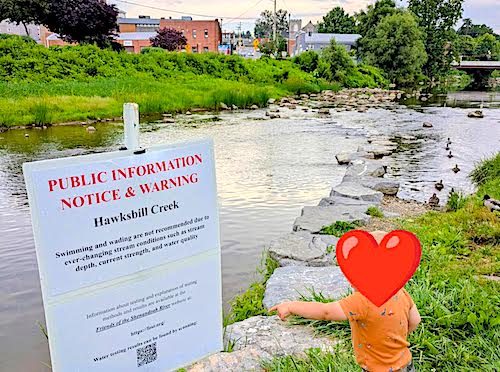
So back at the Greenway with my son Wednesday night, I saw that the Town of Luray has become aware of the problem at hand and has posted signage right at the creek as a “Public Information Notice & Warning” stating: “Hawksbill Creek: swimming and wading are not recommended due to ever-changing stream conditions such as stream depth, current strength, and water quality.” Hmm. I felt that “Water Quality” warning was a little lacking in the ‘dangerously high E. coli levels’ department, but I understand we don’t want to scare people. Then below that, they added a second sign stating: “Information about testing and explanation of testing methods and results are available at the Friends of the Shenandoah River website” and then gives the website and a QR code.
Was it worth the risk to let my son have the joy of playing and learning in the water of Hawksbill Creek? That day I decided ‘no’ and the E. coli levels ended up being 435.2 MPN CFU/100 mL, almost twice the max recommended limit. So we just stuck our toes in and then headed back to the car to use some hand sanitizer.
But where else could we go and water we gonna do now?
Tune in for part II.
Dylan Cooper is a Page County native and graduate of Luray High School and Virginia Tech. He is a stream restoration specialist and a registered professional engineer in the State of Virginia. An avid outdoorsman and ardent environmentalist, he currently resides in Luray with his family.
Email: currentsolutionsva@gmail.com
•••
PREVIOUS “Nature Notebook” Columns
Nature Notebook: Rallying for the rivers
Nature Notebook: Take a kid outdoors
Nature Notebook: The wild ride of 2022 is over
Nature Notebook: Oh deer! We’ve got a problem to bear
Nature Notebook: How to fish like a tourist
Nature Notebook: My EV experience
Nature Notebook: Falling Feathers at Fulfillment Farms
Nature Notebook: Early seasons slip-ups and successes
Nature Notebook: The Tommy Harris Buck
Nature Notebook: The summer smallmouth smorgasboard
Nature Notebook: Fishing the Cicada Invasion
Nature Notebook: The Next Generation
Nature Notebook: Near-record deer season in Page Co.; upcoming kids’ opportunities
Nature Notebook: Climate Report – One for the Ice Ages
Nature Notebook: Climate Report – A Look at 2020 Data

Getting the cows out of the creek is the first step. I farm 260a on the Shenandoah and I have gotten a grant from the state to fence off my cows from the water. Other farmers can do the same. Cows represent about sixty percent of the e-coli in the water. Once we remove them, we will be on our way to creating a creek we feel safe in letting our children recreate in.
The National Institutes of Health, results at: (National Center for Biotechnology Information), did a very extensive study of solar disinfection of e.coli bacteria in a Lake Michigan beach. The issue is very complex. They put a lot of effort in covering all the bases.
https://pmc.ncbi.nlm.nih.gov/articles/PMC444827/