

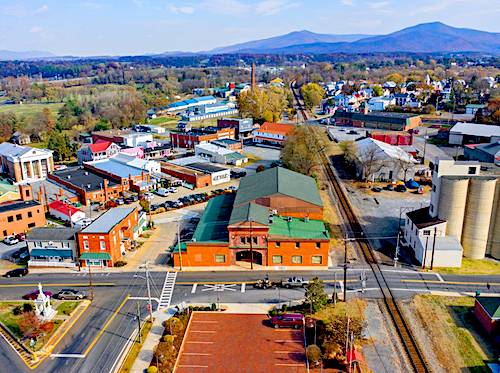
Multi-use project at 15 Campbell St. provides 28 units for workforce housing
By Randy Arrington
LURAY, July 25 — In recent years, officials in the Town of Luray have discussed in depth at numerous meetings how to address issues such as derelict buildings, blighted properties, the lack of affordable housing, protecting historic structures, mixed-use development downtown, and creating opportunities for additional retail and eateries. Four days ago, an announcement came from Richmond that will help address these issues…and not just for a single project in the works now, but it will also open doors to aid multiple projects for years to come.
On Friday, Governor Glenn Youngkin announced that $4.5 million in Industrial Revitalization Funds (IRF) has been awarded to eight projects across the Commonwealth. The Town of Luray was one of two $1 million recipients (the other being the City of Roanoke EDA). The overall $5.4 million in grant awards announced last week included $570,000 in Virginia Main Street grants to 17 communities, and $325,000 in Community Business Launch grants for five projects.
“We are thrilled to partner with business and community leaders to launch projects that will create jobs and strengthen these historic downtowns,” said Governor Glenn Youngkin. “I look forward to seeing these projects create opportunity and prosperity for the Virginia communities that make our state the best place to live, work, raise a family, and do business.”
In total, the funds from three different state sources will support 30 community projects in Virginia “that revitalize historic commercial districts, transform vacant structures, expand small businesses, and bolster local economies,” according to the July 25 press release from the Governor’s Office. The funding will enhance communities, create or expand 19 businesses, generate 142 new jobs, and leverage more than $17.6 million in additional public and private investments.
“These community grants enable Virginia to deliver targeted support for local economic development priorities,” said Virginia’s Secretary of Commerce and Trade Juan Pablo Segura. “The investments will foster local revitalization efforts, offer innovative solutions, drive economic development, and build stronger communities across the Commonwealth.”
The lion’s share of the work done to prepare Luray’s grant application for the IRF state funding was done by Hub Development, LLC, with guidance and input from the Northern Shenandoah Valley Regional Commission and the Town itself. The Virginia-based developer, with headquarters in Richmond, purchased the former Warehouse Art Gallery building at 15 Campbell Street (center of photo above) from the children of Linda Nash in November 2024 for $950,000.
At the end of 2022, Nash ended a 21-year occupancy by the local art gallery of 11,000-plus square feet in the building’s first floor. The Gallery’s 1,000-plus exhibits relocated to two new sites — the fine arts gallery near the corner of Main and Broad, and the Blue Ridge Artists building on Route 211 west of Luray. Nash purchased the building in 2011 and decided to renovate and develop the space for multiple uses. As initial renovations got underway, Nash passed away in 2023 and her children later listed the property for sale at nearly $1.5 million.
“I randomly ran across the building on a commercial real estate site,” said Brad Herman, president and CEO of Hub Development, LLC. “I saw it, I liked it…then I visited, saw it and liked it more. Then I met the community and found a great partner in the Town, and that really sealed the deal.”
Built in 1932, the developer plans to utilize all three levels of the structure and its 33,000 square feet, including the creation of 28 long-term rentals. Among those workforce housing units will be 24 one-bedroom units (two of which will be ADA compatible), three two-bedroom units and one studio apartment. Herman said the renovations, which could reach $5 million, will include the creation of an “everyday diner-type” eatery and co-working space for remote workers.
“The central theme or driving force is workforce housing,” the developer said. “It’s not just, hey let’s put up some cheap housing… I want people to want to come home to these units. I don’t want to build something that I wouldn’t live in myself.”
After spending some time as a corporate attorney in New York City and providing some pro bono work to preserve rent-controlled properties in the Big Apple, Herman said he witnessed ruthless landlords who used immoral and sometimes illegal tactics to kick out tenants so they could charge market rates. He told PVN stories of landlords not depositing rent checks so they could claim non-payment, and one instance in which a landlord didn’t repair extensive fire damage for five years, hoping the tenant would just move out. This experience, he says, drove his company’s mission to create affordable, workforce housing.
“It opened my eyes,” Herman said. “This is not a ‘get rich’ thing…maximizing profit or return is not overall the goal. Yes, we are still a business, but if we wanted to do that we just would turn [15 Campbell Street] into a massive B&B. I believe if people have a job, I believe they have a moral right to reasonable housing near where they work, and that doesn’t always exist today.”
The workforce housing element of the project’s grant application — a statewide issue that Governor Youngkin has been pushing during his administration — was a key part of the IRF application’s success, according to Town Manager Bryan Chrisman.
“It was huge…and it was definitely huge for the Town,” Chrisman said. “Getting 28 units for workforce housing… that’s an enormous thing. Also, there’s the co-work space that gives folks the ability to rent a cubicle with reliable internet.”
IRF grant applications are rated and evaluated on a point system. Chrisman says the $1 million application and award was specifically tailored to this project, and it gained points because of the affordable, workforce housing element, as well as addressing the renovation of a vacant building in the Town’s Historic District that was also considered “derelict” and “blighted” after the utilities were disconnected in 2023.
Chrisman also said the $1 million grant from the state to the Town can be reused after this project to fund future development projects in Luray. As Hub Development moves forward with construction at 15 Campbell Street — potentially getting underway before the end of the year or in the first quarter of 2026 and lasting about 12 months — the developer will submit those expenses to the Town for reimbursement. Those disbursements will serve as a loan to the developer, which must be paid back with interest. Interest rates are dictated by the state, but typically are set around 3 percent. A grant agreement document is created with draws on the money scheduled out, so both the developer and the Town know what to expect. All funds must be dispersed within 18 months.
“The IRF money goes [from the state] to the Town as a grant with no payback, but it’s a loan to the developer,” Chrisman confirmed. “The faster they pay it off, the less interest they pay.”
The Town may use the interest payments in any way they choose, as a new revenue stream flowing into the general fund. However, the original $1 million principal may be loaned out again and again for future projects. In fact, the terms of the application dictate that they must be used in this way, with the Virginia Department of Housing and Community Development (DHCD) approving each disbursement for the initial project (15 Campbell Street) and overall approval for future projects under strict guidelines. The Town Manager said that while the initial state award is “project specific”, it creates an ongoing loan pool for future development.
“It’s not a ‘one-and-done’ like most grants. It’s critical. It’s a huge win for Luray. This grows legs and will help in the future,” Chrisman said. “We, locally, can identify projects and we will have the money to fund new projects and development. Developers will know that money is sitting there for them to use. It can be the key to whether they do it here or somewhere else. It’s a jump starter moving forward. It’s not just this one project. We’re looking forward to not only the immediate impact, but the impact for years to come.”
Two years ago, the Luray Downtown Initiative conducted a survey asking what residents thought about their downtown and what they wanted to see happen in the years to come. While the Hawksbill Greenway was easily rated as the locals favorite feature of downtown, many wanted to see more affordable housing, more mixed-use properties and more restaurants.
“Even though it’s not on Main Street, [15 Campbell Street] is still part of the Historic District that LDI is responsible for,” said LDI Program Director Jackie Wood. “It will provide 28 living spaces and those people will be within walking distance of downtown businesses. Plus, with other things that are going into that building, there will be a co-working space and a restaurant. It’s only adding to what downtown has to offer.”
For more than a decade, LDI has been offering no-interest loans to downtown businesses through a state-issued Community Development Block Grant (CDBG). Appalachian Trail Outfitters recently took advantage of the program, leveraging a $25,000 no-interest loan to expand and update inventory , as well as refreshing the look of its retail space. Il Vesuvio Italian Restaurant & Pizzeria also used a $25,000 no-interest loan to enclose its its outdoor dining area.
“I’ve been talking with Brad the last two years,” Wood said. “I think his concept is amazing, and I think it’s going to be a great addition to the Town.”
Since 1985, the Virginia Department of Housing and Community Development (DHCD) has been providing assistance to localities engaged in downtown commercial district revitalization through the Virginia Main Street Program. The Industrial Revitalization Fund leverages local and private resources to achieve market-driven redevelopment of vacant and deteriorated industrial and commercial properties. In addition, DHCD administers Community Business Launch to support small business creation and fill vacancies in historic downtown districts.
In the 1980s, 15 Campbell Street was the home of Commonwealth Cable, owned by Earl Judy, with a production studio upstairs. It’s been many years since it was actually used as a warehouse, despite the art gallery’s moniker. Following the gallery’s departure after more than two decades, many in town feared that the property might sit vacant for years before finding a new use. Now, in early 2027, the three-story structure is expected to welcome new tenants, new co-working space and a new eatery.
The developer has spent a lot of time over the last two years visiting Luray and working out various issues, from walking out potential parking spaces with members of the Luray Council, to weeding through the details of the IRF application. Although he admits there are still a “lot of moving pieces” involved with the project, Herman says none of his plans at 15 Campbell Street would be possible if not for the cooperation of the Town and the aid of these state funds.
“Those discussions helped evolve and shape the project and improve the project,” Herman said. “Not only does it not make sense to do it alone, I can’t do it alone.”
•••
RELATED ARTICLES
Former art gallery being considered for apartments, co-work space and restaurant
Luray Downtown earns milestone awards with new offerings in the works

Be the first to comment