
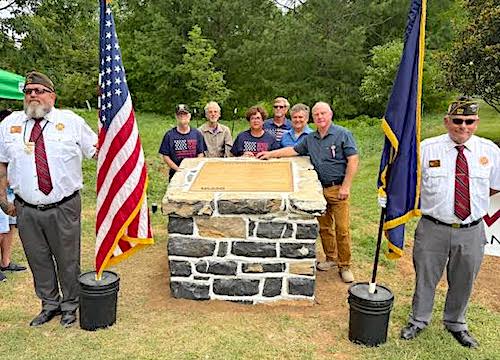
Marker placed near planned greenway expansion to Yagers Spring
By Randy Arrington
LURAY, July 4 — Standing against strong winds while threading two threatening thunderstorms, a small, but dedicated crowd gathered on Saturday along the northern loop of the Luray-Hawksbill Greenway to unveil the third of four markers being placed across Page County to commemorate the 250th anniversary of the nation.
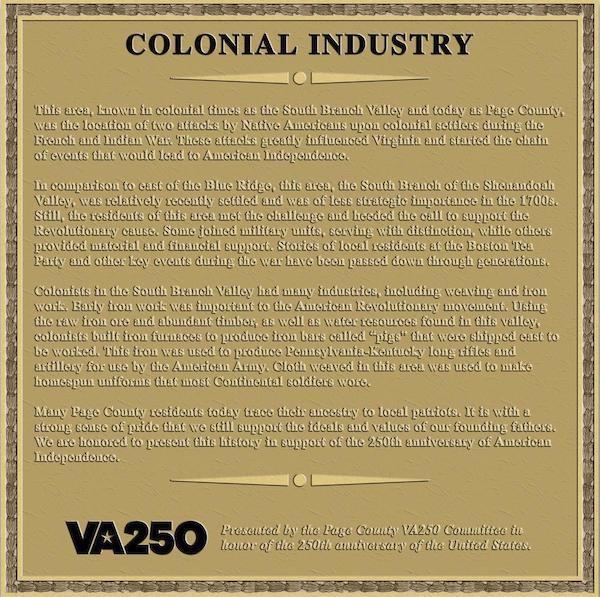
“This area, known in colonial times as the South Branch Valley and today as Page County, was the location of two attacks by Native Americans upon colonial settlers during the French and Indian War. These attacks greatly influenced Virginia and started the chain of events that would lead to American Independence,” reads the opening paragraph on the Luray plaque.
All four of the 200-pound bronze plaques being dedicated across Page County were created by local Marine combat veteran and artist Joe Winslow, who not only has his work in the White House but was also a model for D.C.’s World War I memorial dedicated in the fall of 2024. Winslow serves as treasurer of the local VA250 Committee. Luray Caverns provided the limestone base, which was crafted by local Appalachian artisan Clyde Jenkins.
“In comparison to east of the Blue Ridge, this area, the South Branch of the Shenandoah Valley, was relatively recently settled and was of less strategic importance in the 1700s. Still, the residents of this area met the challenge and heeded the call to support the Revolutionary cause. Some joined military units, serving with distinction, while others provided material and financial support. Stories of local residents at the Boston Tea Party and other key events during the war have been passed down through generations,” the plaque continues.
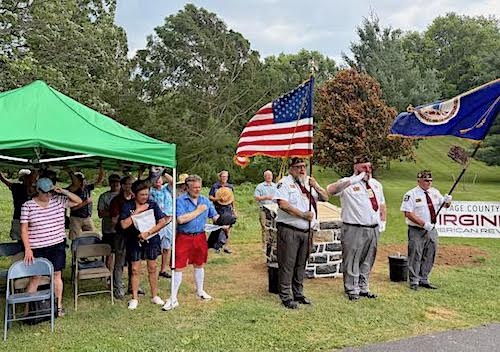
“We appreciate you joining us for this special event and especially given the weather…as we celebrate freedom and independence and our 250th year of America…how blessed we are to live here,” Mayor Stephanie Lillard said at the July 4th event. “We always show up for our community. I’ve witnessed this countless times…and we must remember the possibilities we have before us and the responsibility in shaping it for the generation after us.”
Page County was among the first localities in the commonwealth to sign up for the VA250 campaign a few years back. The county is funding the creation and mounting of the four plaques through a $40,000 allotment of Transient Occupancy Tax (TOT) funds. Rebecca Armstrong, of the Page County Economic Development and Tourism office, coordinates the local VA250 program and its appointed committee. It was that 11-member committee that chose the four themes being interpreted at four locations in the county.
The Town of Shenandoah kicked things off on May 22 with the dedication of a marker recognizing “Religion in Colonial Times.” The historical marker was attached to the First Street side of the Shenandoah Museum near its entrance. It draws on its theme from Fourth Street’s St. Peter Lutheran Church. Founded in 1733, the Shenandoah church is the second-oldest Lutheran church in Virginia.
On June 27, the Town of Stanley unveiled the second marker honoring “Colonial Agriculture” along the walking trail at Ed Good Memorial Park, which recognizes the long tradition of farming in the Page Valley.
Luray’s marker focuses on “Colonial Industry” and sits along the northern loop of the Luray-Hawksbill Greenway, where the linear park is planned to extend 1,200 feet to reach Yagers Spring and the Redwell-Isabella Furnace Historical District.
The Redwell-Isabella Furnace first fired on Sept. 27, 1787 — one of the most advanced furnaces after the Revolution — just days after the U.S. Constitution was signed by 39 delegates on Sept. 17, 1787 at the Constitutional Convention in Philadelphia, Pennsylvania. Most of its iron activities would be shut down by 1841, but ore fired at the site was used for national defense, as well as construction efforts at the University of Virginia and Monticello. Isabella Furnace, as it was later known, also helped provide the materials that created the first structures in Luray.
“Furnaces like this gave birth to the Industrial Revolution to come,” local historian and Committe Chairman Rod Graves told the crowd on Saturday. “Luray did not even exist…the village around the iron works contained about 200 workers and their families — all gathered around a circle around this area right here. This industry, particularly iron [works], helped us forge a new nation.”
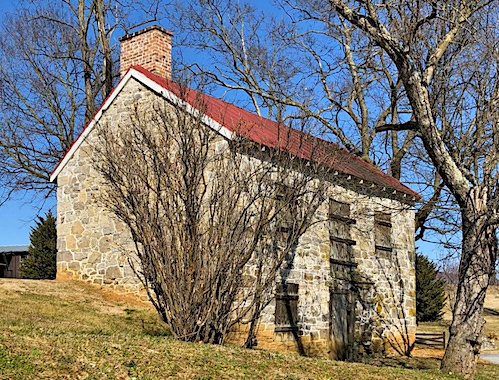
The historical district sits on nine acres just north of Luray on the west bank of Hawksbill Creek. The VDHP website states the “steeply-to-gently sloping site consists of pasture, woodlots, and the oblong pool of Yager Spring, the power source for the furnace and later mills. Derrick Pennybacker is believed to have established the Redwell Furnace in 1787, making it the county’s oldest iron furnace.” After it stopped firing iron ore in 1841, it was “subsequently, a forge, flour mill, and woolen factory operated at the location into the late 19th century.”
The historic district includes a cemetery, a stone foundation, the furnace bridge mound, the Isabella Furnace Office — a two-story stone building with Georgian interior detail — and the Yager Spring House, which pumps millions of gallons of water into the Hawksbill Creek each day. The property also contains a two-story stone structure with a large fireplace for cooking and a later 1965 stone-and-frame addition.
“This plaque is so appropriate to this town and this location,” said Luray Councilman and Committee member Chuck Butler, who played a part in drafting the text for the plaques. “This area right here had some of the greatest industries in the region from Redwell Furnace to the tanning industry, which lasted until at least the 1980s…I just hope our leaders today have as much vision as our Founding Fathers and bring back industry again.”
“Colonists in the South Branch Valley had many industries, including weaving and iron work. Early iron work was important to the American Revolutionary movement. Using the raw iron ore and abundant timber, as well as water resources found in this valley, colonists built iron furnaces to produce iron bars called ‘pigs’ that were shipped east to be worked. This iron was used to produce Pennsylvania-Kentucky long rifles and artillery for use by the American Army. Cloth weaved in this area was used to make homespun uniforms that most Continental soldiers wore,” reads the new Luray VA250 plaque.
The greenway expansion to the historic district at Yager Spring is nearing the construction phase, according to Greenway Foundation President Bill Dudley.
“The expansion to Yager Spring is a 1,200-foot expansion of the existing greenway at the northern loop… with a new and rebuilt dam… a bridge over the creek…interpretive signage and restructuring of the Redwell Furnace village,” Dudley told the crowd. “The organization is still raising funds for the construction phase of the project, with the preliminary planning and engineering studies completed. You can see a video of the plans for expansion at our website.”
Much of the history encapsulated in these historical markers being placed across the area occurred well before the county formed in 1831 and took the namesake of former Virginia Governor John Page. And before the iron works village of Redwell Furnace would grow and incorporate into the Town of Luray in 1812. The battles of the French and Indian War referred to earlier took place in then Dunmore County — which would later become pat of Shenandoah County…and then eventually, Page County.
The new historical plaque placed along Luray’s greenway concludes: “Many Page County residents today trace their ancestry to local patriots. It is with a strong sense of pride that we still support the ideals and values of our founding fathers. We are honored to present this history in support of the 250th anniversary of American Independence.”
LAST dedication planned by the Page County VA250 Committee:
• Labor Day – Monday, Sept. 7 (time TBD) — Page County Courthouse, marker will honor local soldiers of the Revolutionary War. The marker, created by retired Marine Joseph Winslow, will have a base of limestone created by local artisan Clyde Jenkins.
For more information about the Page County VA250 Committee,
•••
RELATED ARTICLES
Stanley honors colonial agriculture with VA250 marker
Shenandoah unveils Page County’s first VA250 marker

Be the first to comment