
~ Press release provided by Virginia Farm Bureau Federation
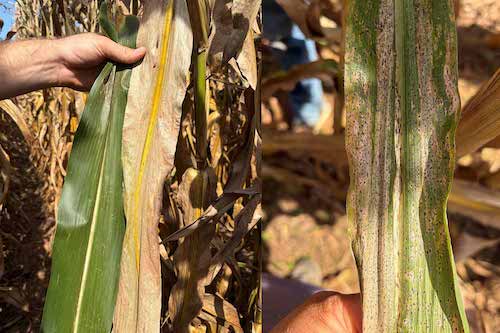
BLACKSTONE, Sept. 24—The destructive corn tar spot is continuing its spread across the commonwealth — disrupting harvests and confounding growers with misleading symptoms.
Caused by the fungus Phyllachora maydis, the emerging disease was first identified in the U.S. in 2015 and has reached corn fields across the mid-Atlantic region. Tar spot was first detected in Virginia in 2022 and has since been confirmed in Augusta, Culpeper, Rockingham and Shenandoah counties, with photo evidence of disease presence in Page and Madison counties as well.
In Midwestern states, tar spot has caused yield losses of 25 to 30 percent, with some severely affected fields losing up to 60 bushels per acre.
“While tar spot is still relatively new to Virginia, it has the potential to become an economically important disease if environmental conditions favor its development,” said Yuan Zeng, assistant director of the Southern Piedmont Agricultural Research and Extension Center and Virginia Cooperative Extension plant pathology specialist.
Rosemary Life, Rockingham County agriculture and natural resources Extension agent, is working closely with Zeng and fellow Extension agents to help growers identify and respond to the disease.
“I have a strong feeling that corn tar spot has been in Virginia since before 2022, and we’re seeing an uptick in identifications because more people are learning what it is and what to look for,” she mused. “I visited a field just the other week, and I didn’t even have to get out of my vehicle to see tar spot—it was that bad.”
While tar spot can resemble general mold spores, it’s “unlike any other disease” that corn growers have navigated, Life cautioned.
“A lot of the traditional methods of protecting yourself from disease don’t work with tar spot,” she noted. “You can do a really good job rotating your crops and applying fungicides, but if your neighbor has it, you can still end up with tar spot because it’s spread through spores and storms.”
Early detection is critical to controlling disease spread. Moderate temperatures, high humidity, extended overnight leaf wetness and frequent fog create ideal conditions for disease development. Visible signs typically appear within two to three weeks of infection.
Tar spot first appears as raised circular or oval black spots on the upper and lower surfaces of leaves. Farmers who observe suspicious spots should contact their local Virginia Cooperative Extension office for diagnostic help and additional recommendations.
While planning for next year’s crop this fall, growers should consider the following disease management strategies:
- Scout fields regularly, and keep record of detected tar spot in fields.
- Select hybrids with lower susceptibility or greater tolerance to the disease.
- Plan crop rotations to help reduce the amount of fungus present in fields.
- Budget for fungicide
- Explore available Crop Protection Network management tools for tar spot disease:
“Don’t panic if tar spot is present,” Life advised. “Reach out, have someone confirm it, and learn more about the disease, when it’s a problem and when to spray.”
For additional information and guidance on disease management strategies, growers should consult with their Extension agent,
visit the Extension publications page or reach out to Life at 540-564-3080.
•••
RELATED ARTICLES
State of emergency declared to help farmers affected by statewide hay shortage
Expanded testing facilities to help livestock producers
August produces nearly six inches of rain
Farm Bureau warns increased beef imports could harm Virginia cattle herd recovery
Additional 40 Virginia localities receive USDA drought disaster designations

Be the first to comment