
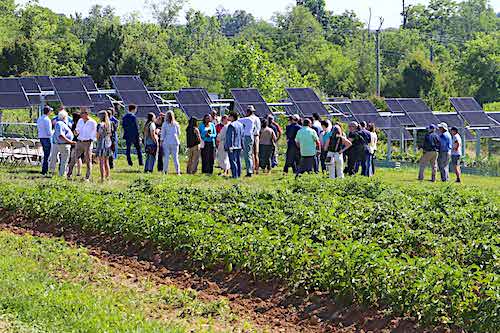
~ Provided by Virginia Farm Bureau Federation
ALDIE, June 24—With pressure mounting statewide to preserve farmland while expanding clean energy infrastructure, Virginia farmers were essential in shaping the official definition of “agrivoltaics”—before others could define it for them.
A formal definition for agrivoltaics, which integrates solar energy into agricultural production, is crucial for well-developed, properly sited agrivoltaics, and preventing poorly developed projects. Codifying its definition also serves as a framework for building policy and incentive structures for agrivoltaics projects.
Flanked by agriculture leaders and environmental advocates, Gov. Abigail Spanberger signed legislation that officially defines the term agrivoltaics in the code of Virginia on June 17 at The Piedmont Environmental Council’s Community Farm at Roundabout Meadows. The farm is the site of Virginia’s first crop-based agrivoltaics project, located in Loudoun County.
Virginia previously lacked an official definition for agrivoltaics.
“By establishing clear, enforceable definitions of agrivoltaics in the code of Virginia, we are protecting farmers,” Spanberger said. “We are making clear that the use of agrivoltaics prioritizes agricultural productivity, keeps land in production for the life of the solar array, and is part of an existing farm business.”
Working alongside PEC, Virginia Farm Bureau Federation helped develop the agrivoltaics definition that will ensure dual-use solar projects take best management practices into account. Inclusion of farmer input in defining agrivoltaics safeguards the state’s agricultural heritage while facilitating on-farm solar projects.
“Defining agrivoltaics represents a practical path forward for farm sustainability—keeping land in production while creating new opportunities for income and energy independence,” said VFBF President Scott Sink. “When we prioritize agriculture first and integrate solar thoughtfully, we can protect our farms today and strengthen them for the next generation.”
The bill was a priority for the governor, a critical legislative issue for Farm Bureau, and garnered strong bipartisan support. Code now defines agrivoltaics to mean “… the intentional co-location of agricultural production and solar energy generation on the same land” that:
- is designed to prioritize and sustain agricultural productivity while integrating renewable energy;
- allows the ongoing production and sale of agricultural products throughout the solar array’s life;
- is a part of an existing farm business; and
- ensures flexibility for farmers to adapt to market conditions and support operational needs.
Agrivoltaics projects can be crop- or livestock-based. For example, beef cattle can graze beneath solar panels that are elevated 7 to 10 feet, spaced widely to provide essential shade for the herd, sustaining long-term land income while reducing the cattle’s heat stress. Other livestock agrivoltaics projects use sheep to manage vegetation.
PEC’s Community Farm crop-based agrivoltaics project serves as a demonstration site for farmers, installers, developers and policymakers. Beets, broccoli, garlic, kale and lettuce are growing under 42 solar panels mounted 6 to 8 feet high on a quarter acre. The panels power the farm, eliminating the electricity bill, with battery backups generating income by selling excess power back to the grid.
•••
RELATED ARTICLES
Governor Spanberger announces $23 million investment by MSolar in Mount Jackson

Be the first to comment